
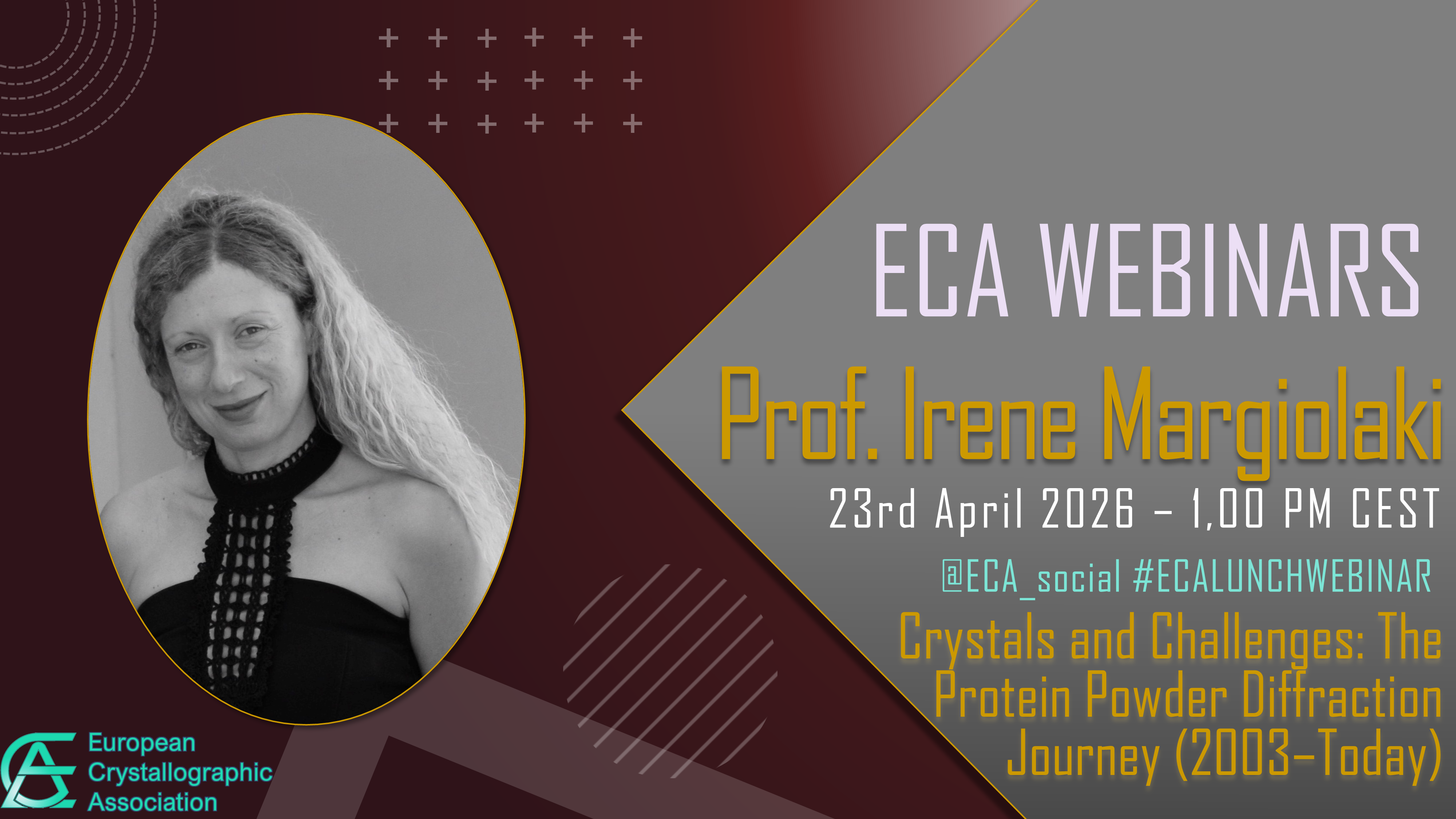
Department of Biology, Section of Genetics, Cell Biology and Development, University of Patras, GR-26500 Patras, Greece
Among the various techniques available for structure determination, macromolecular X-ray powder diffraction (XRPD) [1–2] has evolved over the past decades from an almost impossible dream into a robust and respected analytical method. XRPD can be employed in biosciences for multiple purposes, including the observation of phase transitions [3–4], characterization of bulk pharmaceuticals [5], accurate structure determination, and the detection of ligands in protein–ligand complexes [6].
This presentation highlights selected case studies that demonstrate the power of state-of-the-art infrastructures available at the ESRF, including:
• The investigation of molecular and crystal polymorphism in microcrystalline protein drugs against diabetes, aiming to improve therapeutic performance through the development of microcrystalline formulations and the combination of human insulin (HI) with pharmaceutically active organic ligands.
• Studies of the structure and dynamics of proteins from newly emerging, high-risk RNA viruses, with the goal of supporting antiviral drug design and exploring crystallographic fragment-screening as a powerful approach for the discovery of novel inhibitors. These studies contribute essential knowledge to EU projects focused on pandemic preparedness (EVA & VIZIER).
• The development and integration of methodologies for enhancing peptide-based drugs, providing crucial information to optimize absorption, distribution, metabolism, and excretion (ADME) properties through extensive peptide and protein polymorph screening.
• In situ investigations of pharmaceutical peptides and proteins under controlled variation of physicochemical parameters, such as relative humidity and temperature, offering unique insights into structural stability, hydration dynamics, and phase behavior; factors that are essential for optimizing formulation and storage conditions of therapeutic biomolecules [7-8].
Together, these studies illustrate the transformative potential of synchrotron-based techniques in pharmaceutical structural science, bridging the gap between molecular understanding and drug development.
1. Margiolaki, I., “Macromolecular Powder Diffraction”, Book Chapter for the International Tables of Crystallography- Volume H: Powder Diffraction, chapter 7.1, 718-736, (2019).
2. Karavassili, F. & Margiolaki I., (2016) Protein & Peptide Letters 23, 3, 232.
3. Spiliopoulou M. et al., J. Appl. Cryst. (2021). 54, 963.
4. Fili S. et al., IUCrJ. (2015). 4, 2, 534; Triandafillidis D. P. et al., Acta Cryst. D (2020). 76, 1065.
5. Karavassili F. et al., Biomolecules (2017). 7, 3, 63.
6. Margiolaki I. et al., J. Am. Chem. Soc. (2007). 129, 11865; Triandafillidis D. P. et al., Acta Cryst. D. (2023). 79, 374-386; Karavassili F. et al., Acta Cryst. D (2020). 76, 4, 375.
7. Athanasiadou M. et al., SynBio (2024), 2(2), 205-222.
8. Kontarinis A. et al., J. Appl. Cryst. (In Press), https://doi.org/10.1107/S1600576725007484
Intro + ~45min + ~15min Q&A
When: 23rd April 2026 at 13:00 CEST (i.e. 1:00 p.m. in Paris/Berlin/Vienna…).
Where: Online :::::::link to registration:::::::
You have the chance to receive an info-mail when a new webinar is going to take place. Click here to register for our newsletter.
For inquiries please send a message to eca-webinar_at_ecanews.org.
About the ECA Lunch webinars:
The ECA lunch webinars with an educational or scientific focus were invented following the strong wish to strengthen and vitalize the European crystallographic community. They are a monthly webinar series by the European Crystallographic Association (ECA) and involve all GIGs/SIGs.
The webinars are organized in an online setting such as Zoom (45min + 15min Q&A) and take place every first or second (depending on the schedule of other ECA activities) Thursday of a month at lunchtime (1:00 PM CET). Webinars will be announced via social media, mailing list, and here.
Breternitz, Joachim
Gaidamaka, Anna
Germann, Luzia
Hans, Philipp
Mazzeo, Paolo P.
Morana, Marta
Pisacic, Mateja
Prencipe, Michele